“Doubt, Confusion, and Dismay”: Saving the Records of Congress during the War of 1812
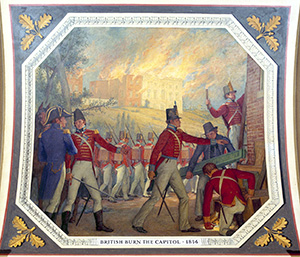
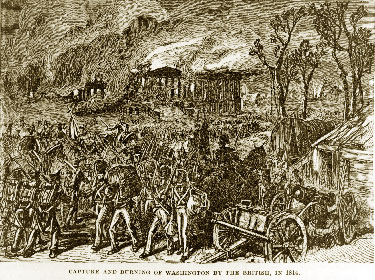
Three days “before the destruction of the Capitol by the British, all in the City was doubt, confusion, and dismay.” The once crowded streets were now deserted. Able-bodied men had left for military service. Women, children, and the elderly escaped to the countryside. The businesses were closed, and “every means of transportation” was in use. So wrote the Senate clerk, Lewis Machen, as he recalled the fearful atmosphere in Washington just prior to the British invasion on August 24, 1814 during the War of 1812. 1
Expecting an attack, the Capitol’s few remaining House and Senate assistant clerks worked hard to remove their chambers’ records. They lacked enough wagons, though, to carry them all to safety. Without supervisors to direct them, they frantically gathered the most important documents. Then, they fled for their own safety. After the Capitol burned, the clerks returned to salvage items from the ashes. They found there was little left to recover.
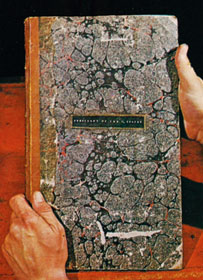
The clerks’ efforts to save the congressional records had mixed results. In both the House and the Senate wings of the new Capitol Building, priceless records were destroyed and priceless records were preserved. However, the House of Representatives’ account listed what was lost. The Senate account listed what was saved. 2 The wealthy chief Clerk of the House was forced to resign in disgrace, while an African American messenger won high praise on the Senate floor. 3
***
The invasion occurred two years after Congress declared a state of war between the United States and Great Britain. In one of the early battles, American troops travelled to York, the colonial capital of Upper Canada (present-day Ontario). There, they captured the British fort. Then, they burned the Parliament Building, governor’s residence, and other public and private buildings. One year after the “Battle of York,” the British sought revenge in Washington.
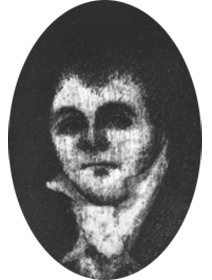
At the time of the attack, Patrick Magruder served as both Clerk of the House and Librarian of Congress. Illness, though, often kept him from his duties. In late July 1814, he departed the hot, humid city in an attempt to restore his health. His brother, George, the principal clerk and an army colonel, took charge of the Clerk’s Office. Another clerk maintained the Library of Congress, then located in a grand room in the Capitol’s Senate wing. 4
According to the assistant clerks, Samuel Burch and John T. Frost, that July, the Capitol did not appear to be in danger. A few British vessels had been spotted in the Chesapeake Bay. However, there were no reports that they were headed to Washington. By the middle of August, though, news arrived that the “enemy was in the bay, in great force.” 5
Burch was called into military service and was forced to march from Washington on August 20th. 6 Two other House clerks joined their artillery company, while Col. George Magruder took command of the District of Columbia’s 1st Regiment. This left Frost, an older man, alone in the Clerk’s Office. 7
Soon, Col. Magruder received word that Burch was desperate to protect the House records. On Sunday, the 21st, he had Burch released from military service. Magruder ordered him back to the Capitol to collect documents “in case the enemy should get possession of the place.” 8
In a frantic burst of energy, Burch and Frost began gathering files on Monday. Still, they were not certain of an invasion, so they set aside committee reports that needed updating. They also decided not to break into Col. Magruder’s locked desk, which held a set of financial documents. 9
Burch tore off in search of a vehicle to transport the books and papers, but could not find an unused wagon or carriage. Finally, a House messenger obtained a cart and four oxen six miles from the city, returning to the Capitol after dark on Monday night. The clerks and messengers shuttled the most valuable books and papers to a “safe and secret place” nine miles in the country. They repeated the process until they had to stop the morning of August 24. 10
At that time, Frost had the Library of Congress’s books ready for removal, but no boxes to contain them. 11 Rushing from the building, he took the committee reports to a nearby home built by George Washington. 12 In his haste, however, he forgot “the Secret Journal of Congress,” as well as the locked desk, containing the Clerk’s business receipts. The loss of these receipts would lead to the Magruder brothers’ downfall. 13
Meanwhile, on the other side of the Capitol, Machen was busy collecting the Senate’s documents. He was one of the few men left in the Secretary of the Senate’s Office. The first Secretary, Samuel Otis, had died the previous April. Other clerks had left for military service, but Machen was not currently assigned to an army regiment.
On August 21, Machen tracked down a wagon driver he knew, but the man was reluctant to loan out the vehicle. Claiming the authority of the Senate, though, the clerk not only convinced the driver to turn over both the wagon and the horses, but also had the man travel back to the Capitol to help remove the records. Machen and the unnamed “waggoner” joined a Senate messenger, later identified by Machen as “a black man named Tobias.” The three men packed the books and papers Machen found most valuable. As the sun set, and the wagon could hold no more, they headed to Machen’s country residence in Prince George’s County, Maryland. 14
Along the way, they faced two difficulties. While still within the city borders, a wagon wheel broke. “Without leave of the owner,” the men “borrowed” a new wheel from a blacksmith’s shop. Then, two miles from Machen’s home, the wagon overturned, spilling its contents along the road. Delayed several hours, they finally reached their destination. 15
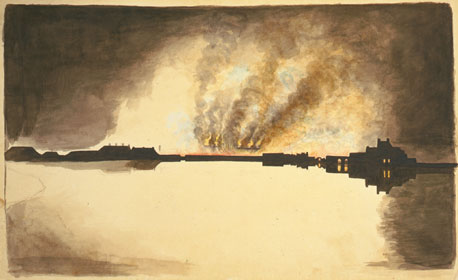
“The Fate of War has befallen the City of Washington,” a newspaper reporter declared on August 30th. The enemy destroyed “the interior and combustible part of the Capitol.” 16 Torched by the invading British, the “combustible part” included the remaining House and Senate records and most of the Library of Congress’ 3000 books and documents.
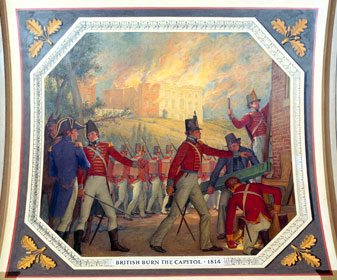
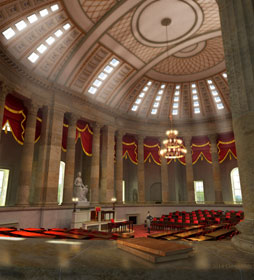
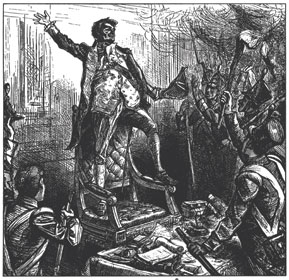
The British invaded Washington after defeating Col. Magruder’s troops at the nearby Battle of Bladensburg. Storming the Capitol, they built a bonfire in the ornate House Chamber. In the basement, they set fire to the committee rooms and the Clerk’s Office. Soon, the remaining papers and furniture, including Magruder’s desk, burned so hot, the soldiers had to leave the wing. 17
On the Senate side, the Library’s books created a tremendous blaze. The flames engulfed the Senate chamber, fueled by the elegant drapery and carpets. The soldiers then burned the White House and the Treasury building. They set fire to a number of private residences, as well, including the George Washington house that sheltered the now doomed House committee reports. 18
Weeks after the catastrophe, Burch and Frost provided Patrick Magruder with a list of the items destroyed. They noted the committee reports and the Secret Journal of Congress (much of which was printed elsewhere). The loss also included manuscript papers dated before 1799, several printed books, and all of George Magruder’s expense records. With sadness, they concluded, all the records, as well as the Library of Congress’s books, would now be safe “if carriages could have been procured.” 19
In the fall and early winter, a House committee reviewed the loss of records. The members criticized Patrick for not providing wagons to transport the records. 20 They also declared that his brother, George, had mismanaged the House accounts. They found that local businesses had overcharged the Clerk’s Office by several thousands of dollars. 21 Since the receipts had burned, there was no way for George to confirm the expenses.
In January 1815, the committee considered removing Patrick from office. 22 Furious, Magruder quit before he could be voted out. In his resignation letter, he wished his replacement “an easier and happier time” in the job and stated his belief that “truth is great, and will prevail.” 23
Unlike the House, the Senate did not examine its clerks’ efforts to save documents. In fact, official records make no mention of those efforts, except for one reference to the messenger named Tobias Simpson. On March 1, 1815, the Senate resolved to pay him, “two hundred dollars, in consideration of his uniform good conduct, and particularly for his exertions to save the public property in the Capitol.” 24
The Senate Journal mentions Simpson several times. It records his wages as a messenger (two dollars a day), as well as extra pay for “good conduct.” 25 The Journal, however, does not reveal one astounding fact: at a time when slaves helped build the Capitol, Simpson, was an African-American freeman. In fact, he was a freeman, who worked steadily, received large bonuses, and received the Senate’s acclaim. No one would have known his ethnicity, though, if Machen had not mentioned it in his own account concerning the removal of Senate records. 26
Writing to a senator years later in 1836, Machen outlined his role in saving many of the Senate’s earliest reports. In the letter, he declared, “It is to me that the Senate and the Country are indebted for the preservation of Records.” Among other documents, Machen, Simpson, and the wagon driver saved a confidential listing of every member of the military, as well as the first twenty-five years of the Senate’s executive proceedings. 27
At the end of his account, Machen wondered how one would feel to lose so much of the Senate’s history, had it been “blotted forever from the knowledge and memory of man”? 28 The same question could be asked regarding the history of the House. While never rewarded for their efforts, the House workers also deserved credit for saving as many records as they did, including the copy of the House bill, signed by Patrick Magruder, which declared war in 1812. Indeed, if none of the House and Senate clerks or messengers had acted, all of the legislative records would have perished in the Capitol blaze. But they did act, and as a consequence, they saved much of the early history of Congress.