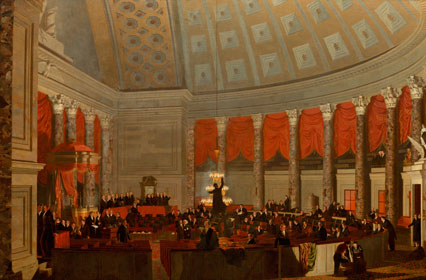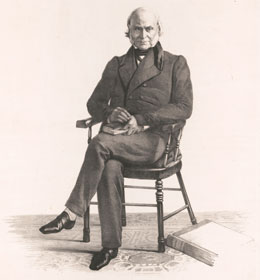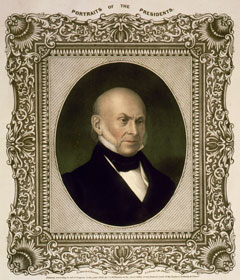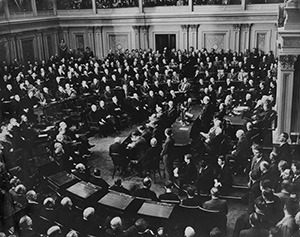
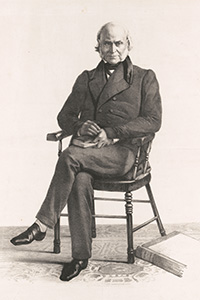
The “old and infirm man, tottering with age and trembling with palsy,” cried “nay!” from his seat on the House Chamber floor.1 No, this legislator would not vote to end a debate. He preferred to argue issues at length, sometimes for hours on end.
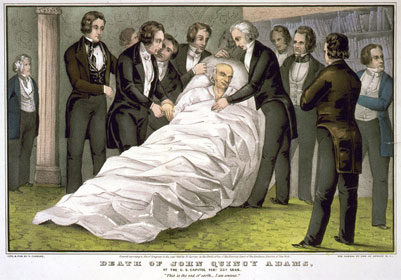
Moments later, though, a terrible stroke sent the old man reeling. He grasped for his desk but could not hold on. Already, he appeared to be in “the agonies of death.”2 Fellow House members watched in horror, then “gave the alarm”: “Mr. Adams! Mr. Adams!”3
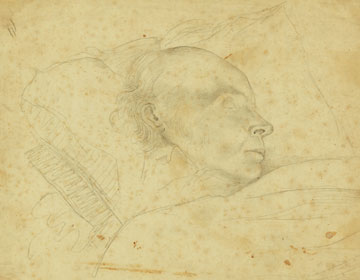
Nathan Sargent, the House Sergeant-at-Arms, witnessed the shocking scene. Years later, he wrote: “There was no mistaking his condition… he was immediately laid upon a sofa and first carried to the rotunda, and then into the Speaker’s room.” Doctors rushed in, along with family members. At first, he had some “consciousness of his situation.” He tried to talk, but his voice was “low and indistinct.” Colleagues and reporters leaned in to hear his final statement. To one congressman, it sounded like: “last of earth—content.” Now the longer phrase, “This is the last of earth. I am content,” is forever associated with John Quincy Adams.4
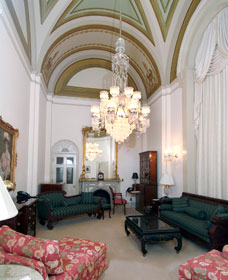
Adams served as a diplomat, secretary of state, senator, and president. After losing his presidential re-election in 1828, he claimed a seat in the House of Representatives. There, he battled the pro-slavery members until his collapse from a cerebral hemorrhage on February 21, 1848. Two days later, he died in the Speaker’s room (now the Congressional Women’s Reading Room). Adams’ death capped more than six decades in public service. For all his accomplishments, “I am content” are fitting last words.
Was he actually “content,” though? According to another source, Adams may have used a different word. On February 26, the newspaper, the National Intelligencer, reported: “Mr. Adams partially recovered the use of his speech” in the Speaker’s room. “In faltering accents,” the dying man observed, “this is the end of earth… I am composed.”5
Perhaps Adams, aged eighty and ready for death, felt composed: calm and collected. Composed also means the careful and intentional use of words. The Massachusetts statesman wrote in a diary every day. He crafted speeches and planned verbal attacks; he rarely spoke without thinking first. In that sense, then, Adams had always been composed, whether he was in the Supreme Court, defending the freedom of Africans, or fighting for the right to petition in the House Chamber. “Old Man Eloquent,” as he was known, used words like a weapon, lacerating all opponents, who tried to shut him down.
***
The son of Pres. John Adams, John Quincy Adams is often linked to the abolitionist movement, which sought the immediate end to slavery. Unlike strict abolitionists, though, Adams had no interest in splitting the North from the slaveholding South. Instead, he worked to preserve the Union without extending slavery into any new territories. For that reason, he opposed westward expansion, achieved through the annexation of Texas (1845) and the Mexican-American War (1846-1848). Adams predicted, correctly, that territorial gains would set the nation on a self-destructive path.
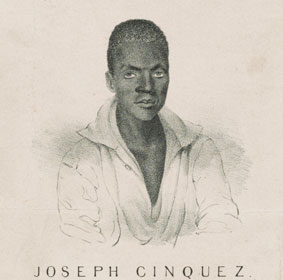
During Adams’ House career, slavery still thrived in the South. However, federal and international laws had already banned the external slave trade. In July 1839, these laws were tested when African captives, led by a Mende African called Cinque, staged a revolt on La Amistad, a Spanish slave-trading ship travelling between islands in the Caribbean. The Africans killed the ship’s captain and members of the crew, then ordered the surviving sailors to steer them back to Africa. However, a U.S. brig ship seized the Amistad near the coast of Long Island, New York. Soon, a legal question emerged. Now that the Africans were in America, should they be set free or returned to their Spanish captors, who had engaged in the illegal slave trade?
Abolitionists took great interest in the captives’ fate, defending Cinque and the other Africans during every court proceeding. In 1841, the case landed in the Supreme Court, then located on the ground floor of the Capitol. At this time, the abolitionists sought an additional lawyer, one whose “station, age, [and] character”6 would give importance to the cause. That lawyer was the elderly John Quincy Adams.
For weeks, Adams prepared a lengthy defense statement, but was wracked with worry and doubt. Walking to the Capitol each day, he prayed his “bewildered mind” would not “utterly fail” him.7 When he finally rose to speak, however, Adams found that his “spirit did not sink within.”8 Instead, on two separate days (February 24 and March 1), he commanded the Court’s beautiful, vaulted room, turning it into a “theater of great interest.” Spectators filled the red-velvet seats, excited to see “Ex-President Adams as an attorney at the Bar.”9
Adams’ speech drew from “one fundamental principle—the ministration of justice.”10 He argued that the Africans were not “merchandise” that could be returned to a rightful owner. They were not murderous “pirates”; they were “persons,” who had acted under dire circumstances. As such, they deserved sympathy. “By what right,” Adams concluded in his fierce tone, was sympathy “denied to the men who had restored themselves to freedom” but given to their “oppressors?”11
The Supreme Court justices took just one week to reach a decision. Speaking for the Court, Justice Joseph Story echoed Adams’ main point: the captives were not property. They were “kidnapped Africans, who by the laws of Spain itself [were] entitled to their freedom.” Story declared the captives free and “dismissed from the custody of the Court.”12
Later, Story revealed his own take on Adams’ argument: it was “extraordinary, for its power, for its bitter sarcasm, and for its topics far beyond the record and points of discussion.”13 Abolitionists, too, recognized the power of Adams’ words. Immediately, they published14 his appeal, and Adams himself sent copies to friends, members of Congress, and foreign dignitaries. Now in print, the Amistad case assumed a symbolic importance. Adams had argued, successfully, that Africans could be “persons” and not just “merchandize.” By doing so, he threatened the very foundation of American slavery.
***
Even before Adams gave his famous Amistad appeal, southern legislators considered him the “most obnoxious” member of Congress.15 What made Adams so irritating? Day after day, for years on end, he submitted an endless supply of antislavery petitions.
Under the Constitution’s First Amendment, citizens have the right to “petition the government for a redress of grievances.” Members of the public may draft statements, then pass them on to Congress. In the 1830s, abolitionist groups prepared hundreds of petitions attacking slavery, especially its practice in the nation’s capital. Whether he agreed with them or not, Adams happily submitted any petitions that came his way and relished in the debate that followed.
In May 1836, though, the petition faced a significant threat. Proslavery congressmen, and their northern allies, adopted their own tactic, the gag rule. In a 117-68 vote, the House resolved that all petitions relating to slavery “shall, without being either printed or referred, be laid upon the table, and that no further action whatever shall be had thereon.” In other words, no committee would consider antislavery petitions; they would be cast aside.
Adams, of course, was furious. He called the rule a direct violation of the Constitution. However, the gag, which was re-established each session, did not stop him from submitting petitions. He continued to offer standard antislavery petitions, as well as hundreds of petitions against the annexation of Texas. There were creative petitions, as well, including one that proposed moving the capital farther north, “where the principles of the Declaration of Independence are not treated as a ‘mere rhetorical flourish.’”16 Debates raged on, blocking the House’s business at every turn.
In January 1842, Adams offered a most unusual petition, which may have been a hoax. The petition “prayed” that Adams be removed from his position as chair of the Foreign Relations Committee. Due to his “monomania” with dark skin color, he could not be trusted with U.S.-Mexico relations. Adams, enjoying the spectacle, spent the day defending himself against the very petition he had chosen to submit.17
The following morning, Adams went a step further. He presented a petition from Haverhill, Massachusetts calling for the “peaceable” dissolution of the Union. Adams announced that he did not support the sentiment. Still, his political opponents pounced. They considered his act treasonous and deserving of censure, a harsh punishment for any legislator.18
Following the call for censure, the Speaker turned to Adams: “If the gentleman from Massachusetts wishes to say anything, he will be heard.” Adams, of course, had no plans to stay silent. For two weeks, he dominated the House Chamber, where “every eye was intent upon the time-honoured speaker, in the hall and in the crowded galleries.”19
Adams found the charge of treason, coming from a Kentucky congressman, particularly galling. “Why does the gentleman think his puny intellect can make treason?” Adams reportedly asked. “The Constitution has defined what treason is.” At one point, he had the clerk read from the Declaration of Independence: “the people have a right if oppressed—if the objects for which government is established are not realized—to change or abolish their government.” If people did not have the right to submit petitions, Adams noted, then they certainly were oppressed.20
According to Sargent, Adams never let up; “he reveled in a storm, and however provoked, excited, or irascible he might be, he never lost his self-possession.” Exhausted by debate, House members tabled the censure. The former president would not be reprimanded.21
Satisfied, Adams moved on to other business. After all, he had another hundred petitions to submit. “The circumstances created much merriment in the House,–Mr. Adams offering his petitions as demurely as if nothing had occurred.”22
And so it continued, petition after petition, year after year. Proslavery members could no more stop them than “stop the flow of the Niagara.”23 Finally, on December 3, 1844, the House voted to remove the gag, one more signal that slavery was losing its hold.24 In retrospect, Sargent noted the irony: “Had Southern members” allowed the petitions, they would have ceased. Instead, they stirred the anger between South and the North, triggering the Civil War.25
Sargent concluded, “Providence had decreed that slavery in this country must be extinguished, and those who clung to it were made the instruments of its destruction.”26 If southern congressmen were the instruments of slavery’s destruction, so too, was Adams with his speeches and endless stream of petitions. Even when cast aside, the statements accomplished their goal. Words, Adams knew, have incredible power, especially when they are composed.
***
February, 1848: President James Polk has just signed a sweeping treaty to end the Mexican-American War. Soon, the country will receive a half dozen new territories and even more opportunities to decry the expansion of slavery. Meanwhile, a southern congressman offers a routine resolution. He wishes to thank the generals and majors for their “splendid victories” against Mexico.27 There is some debate and a call to amend the resolution. Frustrated, one member says, “Why not give the vote at once?”
The “old and infirm man, tottering with age and trembling with palsy,”28 objects. No, he will not vote to close discussion. “Nay!” the old man cries.