“The Fight is On”: One Hundred and One Senators and the Civil Rights Act of 1964
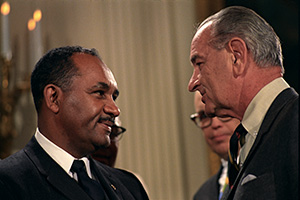
“The Civil Rights Bill is now the pending business in the Senate. The fight is on. We will need every vote that we can get.” Civil rights activist Clarence Mitchell, a.k.a. the “101st Senator,” March 27, 19641
For months on end, he worked late into the night, roaming the corridors of Congress. Reporters cornered him for inside information. Legislators expected him at daily strategy sessions. Every day, he met with dozens of people: politicians, lawyers, and church leaders, those who shared his vision, and those who did not. Indeed, he was such a fixture in the Capitol, the civil rights activist Clarence Mitchell, Jr. earned the title “the 101st senator.”
When the actual senators dined in nearby restaurants, however, Mitchell went without food or headed to the train station for a quick bite to eat. There, he could get served, but many other Washington establishments closed their doors to him. If he travelled, he had to plan carefully. Southern hotels turned him away. Mitchell’s children could not play in the city’s parks or pools. He had friends who struggled to find decent jobs. Some businesses would not let them apply, let alone hire them to work.
Mitchell had an impressive career, though. He served as both the head lobbyist for the National Association for the Advancement of Colored People (NAACP) and the legislative chairman of the Leadership Conference on Civil Rights (LCCR). In his second position, Mitchell led civic and religious organizations seeking to give African Americans equal access to employment and public accommodations, such as hotels, parks, theaters and stores.
In his mild, yet persistent, manner, Mitchell advised Members of Congress as they considered the Civil Rights Act of 1964. He drew support from both political parties. In the Senate, Democratic backers included Majority Leader Mike Mansfield (MT) and Sen. Hubert Humphrey (MN), the bill’s floor leader. On the Republican side, Minority Leader Everett Dirksen (IL) and Sen. Thomas Kuchel (CA) rallied their Members to the cause. These men had what Mitchell called the “essential qualities needed in the Senate . . . an even temper, a good mind, and the ability to be alert after midnight.”2
Mitchell also faced civil rights’ opponents, including Senators Richard Russell (GA), Strom Thurmond (SC), and Robert C. Byrd (WV). They and other Southern Democrats led a record 75-day filibuster. The non-stop debate blocked the bill’s historic path to law. Only a cloture vote, requiring a supermajority (67 out of 100 senators), could end the filibuster, allowing a vote on the bill itself.
Whether for or against civil rights, every senator fought the filibuster battle. Some senators fought for cloture. Others fought against the “tides of change.” There was one gravely-ill senator who fought just to stay alive a few more days. He had a role to play, as well.
Throughout the spring of 1964, Members of Congress considered Clarence Mitchell a fellow warrior. Ever vigilant, his constant presence gave advocates a reason to keep on fighting. Indeed, one hundred and one senators engaged in the epic struggle. And when the fight finally ended, the Senate approved one of the most sweeping civil rights acts in American history.
***
Legislative lobbying is a multi-step process. “Awaken the public” to a problem, persuade elected officials to draft a bill, and get the “votes on the floor.” Some bills also require close monitoring, so that no unwanted amendments are adopted along the way. Mitchell’s LCCR engaged in each of these steps to victory.
In 1954, the Supreme Court’s Brown vs. Board of Education decision banned states from formally segregating public schools. For the next decade, the plight of African Americans headlined the news. Activists condemned violent acts against blacks, as well as the continued segregation of public spaces. On June 10th, 1963, Pres. John Kennedy used military troops to forcibly integrate the University of Alabama. The next day, he urged Congress to enact legislation requiring businesses to serve paying customers, regardless of race or religion. His administration soon submitted a bill with LCCR-approved measures on public accommodations.
Just hours after the president’s speech concluded, the South witnessed the murder of the NAACP field secretary, Medgar Evers. In August, Martin Luther King, Jr. led the historic March on Washington, delivering his famous, “I Have a Dream” speech at the Lincoln Memorial. Then, in mid-September, white supremacists bombed a Birmingham, AL church, killing four young girls attending Sunday schools. These three events gave a greater urgency to the civil rights cause.
As the legislation faced its first House opponents, though, tragedy shook the nation once more. On November 22, Lee Harvey Oswald assassinated Kennedy in Dallas, Texas. Days later, the former vice president, now Pres. Lyndon Johnson, addressed a joint session of Congress. No act could honor Kennedy’s memory more, he told the lawmakers, “than the earliest possible passage of the civil rights bill for which he fought so long.”3
***
In the weeks following Johnson’s speech, public opinion swelled in favor of the legislation. LCCR church leaders, in particular, encouraged thousands of people to call or visit their Members of Congress. In February, 1964, the House approved the bill, which now contained a new provision outlawing employment discrimination based on “race, color, religion, sex, or national origin.”4
Mitchell, however, knew that the real struggle laid ahead. While majority rules the House, in the Senate, a small number of Members can delay proceedings. Southern senators had previously killed civil rights measures with filibusters, or “talking a bill to death.” Now they planned a full-scale attack.
Once the bill crossed to the Senate, Mansfield and Humphrey assumed command. Dirksen headed the Republican effort, while Johnson, a former Senate majority leader, stayed firmly involved. He declared civil rights the year’s highest legislative priority.
Finally, at the end of March, 1964, Mitchell informed the NAACP: “The Civil Rights Bill is now the pending business in the Senate. The fight is on. We will need every vote that we can get.”5
As predicted, the southern Members launched their filibuster. At the start of each daily session, they stood up to speak . . . and speak and speak. The speech-givers argued that they had the right, and even the duty, to preserve local “customs.” Echoing each other’s words, they prevented the Senate from moving forward.
The one defense against a filibuster, cloture, had rarely succeeded and never for a civil rights bill. Two-thirds of the Senate’s Members would have to vote in favor of limiting debate. Mansfield, Humphrey, Dirksen, and Mitchell leaned on every Democrat and Republican who might be persuaded to join their side.
Eager for information, Johnson summoned Mitchell and the LCCR’s head lawyer, Joseph Rauh, to the White House. Or, he called Mitchell at his home in Baltimore. More than once, Mitchell heard the Johnson refrain: “Clarence, you can get anything you want if you’ve got the votes. How many votes have you got?”6
From years of lobbying, Mitchell knew that he had to count every vote, not just estimate a figure. Yet, during the weeks of debate, some senators were reluctant to state their intentions. Mitchell read their behavior for clues. One senator joked that if Mitchell was “not kicked out of a senator’s office,” he assumed he had the Member’s support.7
Mitchell tracked the chamber proceedings from a seat above the Senate floor. Once, a Florida senator looked up, spied Mitchell and Rauh, and said, “There they are, those vultures of the gallery.”8 Those “vultures” were not passive observers. Their attendance reminded the cloture-seekers to stay on task and wear down the opposition.
For that reason, Mitchell kept a tally of senators responding to quorum calls. Senate rules require at least 51 senators present in order to conduct business. When the southern Members grew tired of talking, they would say, “I suggest the absence of a quorum.” Senators had just a few minutes to report to the chamber. Otherwise, proceedings stopped cold, giving the bill’s opponents a much-needed break and the sense that they held the winning hand. Thus, Mitchell made sure that senators maintained a quorum. On at least one occasion, he even arranged a police escort to bring wayward Members back to the chamber.
Nobody expected Sen. Clair Engle (CA) to answer quorum calls, though. In the previous year, he had two surgeries for a brain tumor, leaving him partially paralyzed. The once “active, colorful and outspoken” senator struggled with words; eventually, they did not come at all.9 By late spring, he was “mostly bedridden” and near death.10 Still, Engle expected to fulfill one “final act as a public servant.” He would vote for cloture.11
The Senate leadership scheduled the vote for June 10th. Three months into the filibuster, the bill’s opponents had talked enough; it was time to move on. West Virginia’s Senator Robert C. Byrd, however, had one more long speech to give. Starting the evening of June 9th, Byrd lectured on states’ rights and federalism for 14 hours straight. Mitchell stayed up with him, watching from the gallery.
After Byrd’s speech concluded the following morning, the filibuster’s chief leader, Georgia Sen. Richard Russell, delivered his closing statement. Anticipating defeat, he blamed (or gave credit to) the National Council of Churches, an LCCR organization, for stirring up the public. “I have observed with profound sorrow the role that many religious leaders have played in urging the passage of the bill.”12
Minority Leader Dirksen provided the pro-civil rights remarks. “The time has come for equality of opportunity in sharing in government, in education, and in employment. It will not be stayed or denied. It is here.”13
Just before the voting began, the long-time champion of civil rights, Sen. Hubert Humphrey, viewed the gallery. The future vice president noted it was “filled with citizens of the United States, black and white, watching our democratic process . . . . Among those faces were many with whom I had worked closely in recent days, for months, for years. Our eyes, when they met, flashed an unmistakable message: ‘We are together and we are going to win.'”14
In the gallery’s second row, Mitchell sat with Roy Wilkins, executive director of the NAACP and co-founder of the LCCR. The “battle companions” watched the floor as 99 senators streamed in to vote. Then, according to the Baltimore Sun, “the unexpected hundredth senator arrived. He was Clair Engle of California, who came to the Capitol in an ambulance and was brought in on a folding wheel chair. He was pale after two brain operations, his hair even whiter than it used to be, his right arm in a sling. He waited there on the Democratic side as the vote approached.”15
Next came “10 minutes of high drama.” The clerk called the roll in alphabetical order. Senators responded with “ayes” for cloture, “nays” or “nos” against it. The New York Times reported, “A few of the ‘ayes’ and ‘nos’ echoed like pistol shots in the quiet chamber. Some Senators cast their votes so softly that they could scarcely be heard. Senator Robert C. Byrd . . . slumped wearily after casting his ‘no’ vote.”16
Hearing his name, Engle signaled a wordless affirmation. The Sun stated, “He slowly raised and lowered his left hand three times, from the wrist. He nodded. His lips moved but there was no sound.”17 Other observers thought Engle reached for his eye, a fitting act for a man who clearly voted, “Aye.”18
Finally, Republican Sen. John Williams (DE) “sealed” the vote with the 67th aye.19 Mansfield shouted, “That’s it!”20 Senators sighed in relief or despair, while the “N.A.A.C.P. officials shook hands with several persons sitting near them.”21 “In a gesture of deep satisfaction,” Humphrey thrust his arms into the air.22
After the vote concluded, lobbyists and reporters streamed out of the Senate chamber, meeting again on the Capitol steps. In one hundred degree heat, “beads of perspiration ran down” Mitchell’s “unshaven face.”23 In response to a reporter’s question, he said he was tired and hadn’t eaten much, but “this bill was my meal.”24
Mitchell spoke briefly to the press, then sprinted away to thank people for their support: Justice Department staffers, Dirksen, even Richard Russell, for conducting a civil debate. Meanwhile, Roy Wilkins turned to the television cameras and declared: “Clarence Mitchell was the man in charge of this operation.” He directed a “wonderful group of representatives of church, labor and all facets of the community to make this possible.”25
In the end, the Senate voted 71-29 for cloture. Thurmond called it a “sad day for America,” while Sen. Jacob K. Javits (NY) announced it was “one of the Senate’s finest hours.”26 The Senate enacted the bill on June 19th, and on July 2nd, Mitchell, Rauh, Wilkins, King, and other activists witnessed Johnson sign the Civil Rights Act into law.
Years later, Byrd expressed regret for his segregationist past and his role in the 1964 filibuster. If Engle had any regrets, they did not involve the Civil Rights Act. Before his death on July 30, he voted for both cloture and the actual bill. The first Japanese-American senator, Daniel Inouye, considered Engle’s last vote “a most appropriate culmination to an outstanding career.”27
Clarence Mitchell remained one of the most successful civil rights lobbyists, helping to pass the Voting Rights Act (1965) and the Civil Rights Act of 1968, otherwise known as the Fair Housing Act. He also inspired his political family. Mitchell’s wife, Juanita, was a prominent activist in her own right, and his brother, Parren, served as Maryland’s first African American Member of Congress.
On June 30, 1980, Pres. Jimmy Carter awarded Mitchell the Presidential Medal of Freedom. His citation stated, “The integrity of this 101st Senator . . . . helped translate into law the protests and aspirations of millions.” Indeed, Mitchell was both a “brilliant” advocate for the public and an outstanding Senate colleague.28 Like the best senators, he had the “essential qualities needed . . . an even temper, a good mind, and the ability to be alert after midnight.”29