Jeannette Rankin: “She Raised Her Voice Alone”
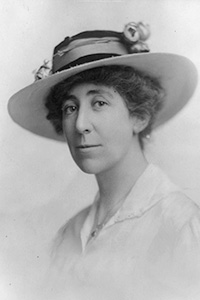
Jeannette Rankin is remembered, and celebrated, for being the first woman elected to Congress. In fact, she won her election four years before the Nineteenth Amendment’s ratification in 1920 gave women the right to vote nationwide. When Rankin took her seat in the House of Representatives, the other members (all men, of course), surrounded her, shaking her hand. The clerk called her name, Miss Rankin, and cheers erupted throughout the House Chamber. Lost in the accolades of being first, though, was the loneliness of being the “only.”
After her election in 1916, one Kentucky reporter marveled at Rankin’s nerve to serve as the lone female in Congress. Was there any man willing “to become one of a deliberate body made up of 434 women and himself?” No, he concluded, a man in that position would have his “courage ooze from the palms of his hands.”1
Rankin’s bravery was tested on April 6, 1917 when she cast her first vote in office. On that day, the House voted in favor of declaring war against Germany (what would later be known as World War I). Yet, Rankin, along with forty-nine male members, voted in opposition.2
Now, instead of praise, she received scorn. A Pittsburg reporter accused Rankin of “voting against the flag.” He added, “Weakness, hesitation, timidity and nervous hysteria were displayed when she should have been strong, courageous and calmly determined.”3 Others echoed this attack. They declared that Rankin voted “‘no’ because her feminine emotions [would] not permit her to say ‘yes’ to war.”4 Criticized by both men and women, she left the House after just one term.
Twenty-two years later, Rankin returned to Congress at the start of World War II. This time, when the president called for war, even confirmed pacifists joined the cause. Indeed, the war vote occurred on December 8, 1941, one day after the Japanese attacked Pearl Harbor. Under such circumstances, no legislator dared to vote against the war declaration. That is, no legislator except Jeannette Rankin: “She raised her voice alone.”5
***
Born in 1880, Rankin grew up on a ranch in Montana. After graduating from college, she studied social work at the New York School of Philanthropy. Then, she served as an organizer for the National American Woman Suffrage Association. Travelling throughout western states, Rankin gave speeches on women’s right to vote.6
Rankin’s work in Montana helped that state achieve women’s suffrage in 1914.7 Two years later, she ran for Congress “to repay the women,” who had supported her efforts. Both local and national newspapers covered the race. In October of 1916, the Harlem, Montana Enterprise declared: “Jeannette Rankin, candidate for congress on the republican ticket, is making a phenomenal campaign all over the state.”8 The New York Sun reported, she has “a rare personality, a fine intellect and an unusual perspective.” Meanwhile, the Seattle Times made this conclusion: “Miss Rankin is an excellent speaker, attractive in appearance, and [a] skilled politician.”9
In November 1916, Montana’s voters elected Rankin to be one of the state’s two representatives to Congress. Rankin took the oath of office on April 2, 1917. Boise, Idaho’s Evening Capital News described the scene: “Men and women in the galleries pounded hands together and yelled themselves hoarse; members did the same on both sides of the chamber when Miss Jeannette Rankin, the ‘lady from Montana,’ entered the hall.”10 “Her appearance,” reported the Dillon (MT) Examiner, “was the signal for an ovation, and she was compelled to rise and bow her acknowledgements.”11
In addition to being Rankin’s first day in office, April 2nd marked the start of an “extraordinary” session of Congress. President Woodrow Wilson had called the session in response to German submarine attacks on Atlantic shipping vessels. On April 5th, the House began debating Wilson’s call for war.12
Meanwhile, friends and House members tried to persuade Rankin to vote for the declaration. A “no” vote, they said, would risk the suffragist cause. It would also risk Rankin’s political career.13 Knowing her anti-war views, Rankin’s own brother warned her, “After the vote, there will be nothing.”14
Still, Rankin held firm. At three in the morning on April 6th, the seventeen-hour debate wound down. The clerk prompted each member to vote. Ignoring the first roll call, Rankin responded the second time she heard her name. “I want to stand by my country,” she said, standing, “but I cannot vote for war.”15
While no one disputed her use of the now-famous phrase, how Rankin said those words is uncertain. In an editorial entitled, “Sobbing Jeannette,” Montana’s Big Timber Pioneer claimed Rankin spoke “with a sob and a voice scarcely audible.”16 Other newspapers reported that Rankin shed tears as she voted. An angry Pennsylvania state legislator declared, “This is the time for no agitation. This is the time when we all, with sober minds, must confront the difficulty that presents itself before the entire world at this time. And Jeannette Rankin wept!”17
Rankin, and others, denied that she cried during the vote. However, her voice, most likely, reflected the “stress of great emotion.” She knew that American “boys” would be heading off to war, and many would not return. This understanding triggered quite a few tears on the House floor. According to the Baker (MT) Sentinel, “It was a time when strong men were unashamed of their emotion—the hour, perhaps, of the country’s greatest crisis.”18 And while the public “forgave” congressmen who admitted to crying, the lone congresswoman was not given the same consideration.
With her House seat in jeopardy, Rankin ran for the Senate in 1918, but she lost in the primary election. Nevertheless, the war vote did not destroy her career in public service. In the 1920s and ’30s, Rankin remained active in the peace and social welfare movements. She lobbied Congress on behalf of organizations seeking to prevent war, ban child labor, and improve working conditions.19
In 1940, anticipating another war, Rankin once again won a seat in Congress. Aged sixty, she was described as a “slight, white-haired woman.”20 The following year, that slight woman spoke up “firm and loud” when she voted “no” to war with Japan. As she did so, boos and hisses erupted around her.21
The Washington Post reported that soon after the vote, Rankin “fled, almost in terror, and took shelter in a telephone booth against a barrage of photographers’ flash bulbs and reporters’ questions.”22 She spent the afternoon in her office under police protection.23 Two days later, she faced another war vote. On December 11, 1941, Rankin recorded herself as “present,” but refused to vote for or against the war with Germany and Italy.
In 1917, fifty like-minded House members could turn to each other “for comfort.”24 In 1941, Rankin faced the harsh criticism alone. Newspapers reported her as “disgraceful” and “disloyal.” The Glasgow (MT) Messenger called her, “a fanatical woman who failed to see beyond the confines of her own warped perspective.”25
Rankin did have a few defenders. A teenaged girl wrote to the Daily Missoulian: “Whether we agree with that woman or not, she had the God-given right to stand up and claim her right of free speech.”26 The editor of the Helena People’s Voice offered his opinion. Instead of booing Rankin, “Americans should instead thank God that they have before them her splendid example of courage and conviction.”27 That solitary vote in opposition to war proved that America is a free society, a value worth fighting for.
Rankin’s critics far outnumbered her supporters, however. Once again, she left Congress after just one term. Returning to her work in the peace movement, Rankin led a march to the Capitol Building in 1968. Now, as an 87-year-old, she was not all alone. More than 3000 women joined the “Jeannette Rankin Brigade” opposing the Vietnam War.28
In the years following the march, most writers, regardless of their opinion of war, portrayed Rankin as daring and outspoken–not weak or emotional. Perhaps only Rankin, herself, thought she could have been tougher. Shortly before her death in 1973, she told an interviewer, “If I had my life to live over, I would do it all again, but this time I’d be nastier.”29
***
In 1985, Montana sent a statue of Rankin to the Capitol’s National Statuary Hall collection. The figure depicts a bold woman, with clear eyes, calmly facing the future. The phrase, “I cannot vote for war,” is written across the statue’s base. When these words were first uttered, they were called “weak,” “timid,” a sign of “nervous hysteria.” Decades later, they represent the “courage and conviction” of Jeannette Rankin, the first woman elected to Congress and the only member to vote against both world wars.