The Artist of the Capitol Constantino Brumidi’s “Near Death Experience”
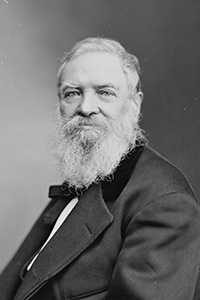
Every guide who gives tours of the Capitol has a favorite story. And every guide has a favorite artist. For many guides, the favorite story and the favorite artist come together in one person: Constantino Brumidi. The Italian immigrant left his mark all over the Capitol.
That mural of George Washington under the Dome? Painted by Brumidi. Those beautiful hallways on the Senate side of the Capitol? Otherwise known as the Brumidi Corridors. Historic committee rooms and fancy reception rooms—Brumidi, Brumidi. And the decorative band wrapping around the Rotunda, the one with the scenes from American history? Well, that would be Brumidi, too.
The band, located fifty-eight feet above the Rotunda floor, begins with Christopher Columbus stepping into the new world. Additional images show the exploration and founding of what would become the United States of America. The last scene in the band—or the frieze, to use the technical term—pictures the Wright brothers’ first airplane flight in 1903. But, the guides reveal, Brumidi died in 1880. How could an artist paint a famous event that had not yet occurred?
The answer to that question is simple: Brumidi did not paint the scene. The story behind the question, though, is fascinating and also a bit tragic. When visitors hear what happened, they gasp. A picture forms in their mind: an old man, in his seventies, dangling from scaffolding high above the Rotunda’s sandstone floor. Some may wonder, though, could a frail, elderly man really save himself in such a dramatic fashion? And, if Brumidi never finished the Frieze of American History, one of the most impressive artworks in the Capitol, who did?
***
Constantino Brumidi is known for more than his work in the Capitol. As a boy in Italy, he studied at a famous arts academy. He learned how to fresco, painting on wet plaster so that the colors become a permanent part of the wall. In Rome, he painted a fresco in the Vatican (the pope’s residence) and murals within a palace and chapel. Forced to flee the Italian Revolution in 1852, Brumidi immigrated to America. While living in New York, he travelled often to paint private homes and churches, including a cathedral in Mexico City. On his way back to his home, Brumidi stopped in Washington to visit the Capitol. That side trip would change his life, not to mention the interior appearance of the building.1
At the time (1854), the Capitol had recently doubled in length to accommodate larger Senate and House chambers. The building was full of blank walls. For an artist, these walls were simply canvasses waiting to be filled. Brumidi was determined to do the honor, with fresco as his chosen technique.
Brumidi offered to complete a sample of his work, a small painting in a meeting room.2 The test assignment won approval, leading to a quarter century of work. In fact, by the time he finished the frieze’s first scene in April 1878, no one could “remember when Brumidi was not painting the Capitol.” As one observer put it, “By the yard or by the mile, by the week or by the year, he paints on, paints ever.”3
If Brumidi was a fixture in the Capitol, so was his work scaffolding. Many of the platforms lifted the artist a mere yard or two. The enormous wooden scaffolding required for the “Apotheosis of Washington” mural raised Brumidi one hundred and eighty feet into the eye of the Dome. Often, Brumidi would lie down on the platform, working “flat on his back,” as he painted on the curved surface seventeen stories above the Rotunda’s floor.4
While lower to the ground, the frieze’s scaffolding was a more complicated structure than the one used for the Washington mural. Attached to the Rotunda’s round walls, the two-level stand moved as work progressed. Three diagonal props of wood supported the platform, as well as ropes connected to the gallery above.
To reach the scaffolding, Brumidi climbed a ladder to the gallery’s balcony, which overlooked the Rotunda floor. He stepped over the railing, then climbed down two more ladders. As one reporter noted, “If he should fall, he would mash down yonder like a basket of eggs.”5
Captivated by the element of danger, visitors entering the Rotunda scanned the scaffolding for a glimpse of the famous painter. They were often disappointed. Weeks would pass when Brumidi was unable to work from the platform. Cold weather or one of his frequent bouts of asthma kept him on the ground.
Even when ill, though, Brumidi continued to work in his studio near the Capitol. There, he produced the designs needed to complete the frieze. He first began sketching scenes before the Civil War. However, that conflict and other concerns interrupted his work, and he did not actually begin painting until 1877. Brumidi was then seventy-three years old, although some reporters described him as a man in his eighties.
The artist’s age, the height of his platform, and the frieze itself was an endless source of fascination. Newspaper reporters noted the frieze’s optical illusion; it appears to be in three dimensions, mimicking a work of sculpture.6 And they described Brumidi’s bare scaffolding, holding nothing “but a wooden chair and a box for a table, and two tall trestles to reach his design.”7 One reporter wondered when he would fall from that scaffolding and break his “Roman nose.”8
Brumidi was well aware of the dangers involved in his work. Still, he continued to use the same two-stage scaffolding. When he grew too weak to make the daily journey up and down the ladders, he used a “derrick” to reach the scaffolding. Each day, workers hauled Brumidi up to the frieze. During busy times, when Congress was in session, dozens gathered to watch the spectacle.9
As winter approached, there were fewer days that Brumidi was able to fresco the frieze, derrick or not. In December, work halted in the Rotunda. As Brumidi explained to Edward Clark, the architect of the Capitol, cold temperatures hardened the plaster before it could absorb the colors, causing “injury to the work.”10 Meanwhile, a leading architectural writer worried that Brumidi would die before completing the frieze, and it would be nearly impossible to find an artist who could finish it for him.11
In the spring of 1879, Brumidi was back on the scaffolding, much to the relief of many in the Capitol. That April, he told the Washington Post that he painted half a figure a day and expected to finish the project within five years. “Do you not find the work beyond your strength?” asked the reporter. “Oh, no, I am not so strong as once. I cannot walk well, or stand, but my arm has lost nothing; my hand and my eye are as good as ever,” Brumidi said. “It is my life-long work.”12
In the summer, though, Brumidi’s asthma worsened. He left the city for the healing springs of Virginia.13 Returning to Washington in August, he felt somewhat better, but he worried about money. Writing to Architect Clark on September 29th, he requested a steady salary. His usual ten-dollars-a-day rate could lead to “starvation,” should his bad health prevent his daily work.14
Two days after requesting job security, Brumidi tumbled from his narrow platform. Newspapers provided similar accounts: he was alone on the scaffolding, seated on his chair, on the platform’s second stage. When he leaned forward to paint a figure, his chair slipped and turned over, throwing him forward. The “helplessly feeble” artist managed to grasp a rung of the ladder between the platform’s two stages. For some time, he “clung” to the scaffolding. Meanwhile, Officer Lamon, of the Capitol Police, was stationed in the Dome’s gallery. He often watched the artist at work and now witnessed the near fall. Officer Lamon arrived just in time “to save Mr. Brumidi, whose strength was exhausted.”15 A Capitol guide also raced to the scene, risking his own life as he passed over narrow ledges to assist Officer Lamon.16 Had no one seen the accident, one writer exclaimed, Brumidi “would have fallen and been dashed to pieces on the floor beneath.”17
The following day, the Baltimore Sun concluded, “the shock was so great that there is no telling how much it will affect him.”18 In fact, the accident affected Brumidi a great deal. While he returned to the fresco within the week, it was only for one day. According to the same Sun reporter, the artist painted for a time from the platform, then “became nervous and was forced to suspend.” Brumidi doubted that he could finish the work. Perhaps another artist, he thought, could transfer his designs to the walls.19
A couple of weeks later, Brumidi confirmed that the “shock to the nerves” threatened his ability to complete the frieze. With perhaps some exaggeration, he informed Architect Clark that he had hung from the ladder, suspended by the strength of his own arms, for “fifteen minutes.” The “miraculous escape,” however, triggered a severe asthma attack and he could no longer perform “continuous work” on the scaffold.20
Brumidi returned to his studio and his work designing upcoming scenes. By January, though, it became clear that Brumidi would never finish the frieze, which was only one-third done. He was “exceedingly anxious” to see it finished, but did not expect to do it himself.21
Brumidi toiled on into winter, working on one last scene before dying on February 19th, 1880.22 While some obituaries mentioned the accident, or his chronic asthma, others concluded that simple old age had taken his life.23 Surrounded by many friends, including several members of Congress, Brumidi was buried in Washington’s Glenwood Cemetery with Clark serving as a pallbearer.24
Following his death, Brumidi was called “the genius of the Capitol.”25 Members of Congress praised his work in speeches on the Senate and House floors. One senator said that he left “creations of imperishable beauty.” Another appreciated his knowledge of American history and its portrayal in the Rotunda.26
While greatly admired, the artist’s final project was only partially finished. Doubt hung in the air; could anyone replace Constantino Brumidi and complete the frieze? In fact, one painter seemed ideal for the task: Filippo Costaggini. Brumidi, himself, had recommended him. He had trained at the same Roman art school as Brumidi and was willing to follow Brumidi’s plans. Costaggini won the assignment and began work on the scaffolding.
When the fellow Italian finished Brumidi’s last design in 1889, however, thirty-one feet of blank wall separated the final “Discovery of Gold” scene from the one depicting Columbus. Costaggini offered to fill the space with his own designs, but Congress could not decide the subject matter. So the decorative band ended abruptly, a glaring strip of white. And when Costaggini died in 1904, it seemed like the frieze would never be complete. Finally, in 1953, the American artist, Allyn Cox, closed the circle with three scenes of his own design: the Civil War, the Spanish-American War, and “The Birth of Aviation,” symbolizing a new era of exploration.27
Now, when visitors tour the Rotunda, they hear the story of Constantino Brumidi and how it took three artists nearly a century to complete the frieze. Some may blame an overturned chair for the delays. The evidence, though, suggests otherwise. Given the years it took Costaggini to transfer the original drawings, Brumidi, with his chronic illness and dwindling strength, had no chance to complete the project, let alone design the additional scenes needed. Sickly and old, Brumidi simply ran out of time. Still, the story is fascinating, and also a bit sad: the “genius of the Capitol,” fearing for his life, high above the Rotunda floor, surrounded by his masterpiece, a “life-long work” unfinished.