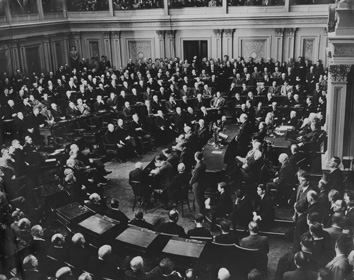
It was the day after Christmas 1941 and Winston Churchill was nervous. The British prime minister paced up and down in the small room off the Senate chamber mumbling to himself as he prepared to face one of the most daunting audiences of his long and storied career: a Joint Meeting of the United States Senate and House of Representatives.1
Inside the Senate chamber, the atmosphere was almost as tense. Barely three weeks before, Congress had declared war against Japan in response to the December 7 surprise bombing of Pearl Harbor. Shortly thereafter Nazi Germany and Italy declared war on the United States. Now, after more than a year of persistent urging on Churchill’s part, Great Britain and the United States, together with the Soviet Union, were finally and formally allied against the three Axis Powers. The British prime minister had come to Washington to discuss the conduct of the war with Pres. Franklin D. Roosevelt.
Under these conditions, Churchill’s speech to Congress was a command performance, and he knew it. The prime minister had prepared carefully, working on his speech right up to the time he left the White House for Capitol Hill. While his colorful oratory and rotund figure were familiar to most legislators from radio broadcasts and movie newsreels, Churchill’s speech was the first time many in the audience, which besides the legislators included members of the Supreme Court, the president’s cabinet, and the diplomatic corps, would see him in person and in action. He had to convince them and a large international radio audience that he and Great Britain would be reliable and relentless allies.2
However, Britain’s situation in December 1941 did not inspire confidence. Shortly before he left for the United States, Churchill had learned that the Japanese had sunk two British battleships in the Pacific, resulting in great loss of life. Even more horrifying, the British colony of Hong Kong had surrendered to the Japanese on Christmas Day while the British prime minister was discussing military strategy with Roosevelt at the White House. Great Britain’s position in Europe was almost as precarious since it was the only country still opposing the Nazis after two years of war.
Roosevelt had been supportive when the news of Hong Kong’s surrender arrived, but Churchill knew he could not count on the same response from Congress. While the Japanese attack on Pearl Harbor had dissipated much of the isolationist sentiment that had previously gripped America, some legislators remained hostile to the prime minister, the alliance with his country, and the U.S.’s involvement in another global conflict so soon after World War I (1914-1918). To add to the pressure, Churchill also knew that Congress controlled the appropriation process for the Lend-Lease Act aid that Great Britain depended on to fight the war.
Despite these pressures Churchill radiated calm and confidence as he stood before a bank of microphones at the clerk’s desk in the Senate chamber. He began with a humorous reference to his own Anglo-American heritage. “I cannot help reflecting that if my father had been American and my mother British instead of the other way around, I might have got here on my own,” he said.3
From there, he moved swiftly to the conduct of the war. While he warned that “many disappointments and unpleasant surprises” awaited the Allies, he nevertheless asserted that they would eventually prevail. “Some people may be startled or momentarily depressed when…I speak of a long and hard war,” he said. “Our peoples would rather know the truth….” The struggle might be long and the enemy ruthless and determined, but “the task which has been set for us is not above our strength…its pangs and trials are not beyond our endurance.”4
He acknowledged that both Great Britain and America had been slow to appreciate the Axis threat. Their failure to rearm in the 1930s had left both countries “at a disadvantage which only time, courage and untiring exertion can correct.” However, he said, Great Britain’s rearmament program had “made very great progress” and America’s support in the form of Lend-Lease aid had bolstered its efforts in the early years of the war.5
Now America’s entry into the conflict had given the conquered people of Europe and Asia new hope and its industrial capacity, while not yet at maximum production, would, when allied to that of Great Britain, “produce results…beyond anything that has been seen or foreseen in the dictator states.”6
Knowing that the Pearl Harbor attack was still uppermost in his listeners’ minds, Churchill then turned his attention to the Pacific. After acknowledging that the dispersal of Lend-Lease aid to Great Britain might have left the U.S. more vulnerable to attack there than it otherwise might have been, he issued a challenge to the Japanese. “What kind of a people do they think we are? Is it possible that they do not realize that we shall never cease to persevere against them until they have been taught a lesson which they and the world will never forget?”7
Churchill’s defiance and his confidence in the Anglo-American alliance were so strong that he dared to end his speech with a vision of a peaceful postwar world where future international conflicts would be dealt with at their “earliest beginnings” and where the United States and Great Britain would together preserve the peace. “I avow my hope and faith …, that in the days to come the British and American people will, for their own safety and for the good of all, walk together in majesty, in justice and in peace.”8
The audience in the Senate chamber responded with a standing ovation that only grew stronger after Churchill flashed his famous “V for Victory” sign with his fingers. According to the Washington Post, “the effect” of that one gesture “was instantaneous, electric. The cheers swelled into a roar.”9 Churchill’s doctor Lord Moran was present, and reported, “The senators and congressmen stood cheering and waving their papers until he went out.”10
Afterwards, individual senators and congressmen praised the speech. Acting House Speaker William Cole (MD) said Churchill’s address would inspire everyone to do their “utmost in the fight for victory.” Sen. John Gurney (SD) said the prime minister’s “appearance as well as…his determination” indicates “that our people can…bank on the complete cooperation of all the citizens and resources of the British Empire.”11 Sen. Millard Tydings’s (MD) reaction was more direct: “You can follow that fellow anywhere.”12 No less a foe than isolationist Sen. Burton Wheeler (MT) grudgingly concluded that the speech was “clever” and “one which will appeal to the average American.”13
Churchill, who at the outset of his remarks had called the occasion “one of the most moving and thrilling of my life,” felt he had connected with his audience.14 “I hit the target all the time,” he told Moran.15
The protocol for a Joint Meeting requires that both the House and the Senate declare themselves in recess either by resolution or by unanimous consent. Joint Sessions of Congress are usually reserved for the president’s annual State of the Union address, other presidential speeches, and the counting of electoral votes for president and vice president after an election. To initiate a Joint Session, both the Senate and the House adopt concurrent resolutions.16
However, since Churchill’s 1941 speech, events of this kind have become more common Many political leaders and heads of state have addressed the Congress, including the presidents of France, Czechoslovakia, Russia, Mexico, and South Africa, the prime ministers of Israel, Ireland, India, and Pakistan, and the monarchs of Great Britain, Spain, Belgium, the Netherlands, Jordan, and Thailand. Most of these leaders have done so only once. Winston Churchill holds the distinction of having addressed a Joint Meeting of the U.S. Congress three times, twice during World War II and once in 1952 when he was again serving as British prime minister.17 Of those three occasions, the December 26, 1941 speech is arguably the most significant as much for its timing as for what he said and how he said it.