Join us in our mission to educate, inspire, and encourage informed civic participation. By becoming an annual member, your support funds vital programs such as the ‘We the People’ Constitution Tour for DC students, free resources and lesson plans for teachers, and our series engaging virtual and in-person public history events. Together, we will preserve Congress’s history and empower citizens to influence the future of our democracy.
Twenty-Five Years After 9/11: What Have We Learned?
by Chuck Hagel
United States Senator from Nebraska from 1997 to 2009 and Secretary of Defense from 2013 to 2015. He serves on the U.S. Capitol Historical Society Board of Trustee as an Emeritus member.
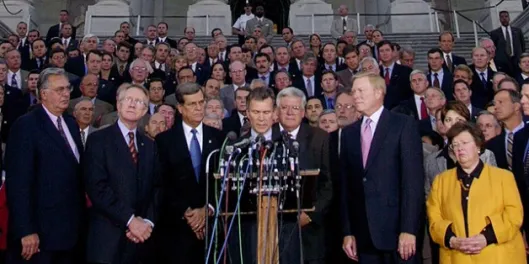
Members of Congress on the Capitol steps on 9/11/01. (Found in National Journal; AP Photo/Kenneth Lambert)
On the morning of September 11, 2001, I was holding a fundraising breakfast at The Monocle restaurant on the Senate side of the Capitol. Halfway into the breakfast, my Communications Director, Deb Fiddelke, came up to me and whispered in my ear that a large plane had crashed into one of the Twin Towers in New York City. I kept going. A couple of minutes later, she came back to me and whispered that the second Twin Tower had just been hit. At that point, I told the group what Deb had told me and said we all had to leave.
I got back to the office just in time to learn that the Pentagon had been hit. The Capitol Police immediately began clearing the congressional office buildings and the Capitol. We went over to the park across the street from my office in the Russell Senate Office Building. After staying in the park for a while with Senate staffers and some senators, including then-Senator Joe Biden, whose office was also in the Russell Building, we all dispersed.
I went back with Senator Pete Domenici to his townhouse on Capitol Hill. We monitored events through TV, phone calls, and our staff. Later that day, Senate Leaders Trent Lott and Tom Daschle got the senators together at the Capitol Police headquarters. We were all, like everyone else trapped in D.C., frantically calling our families. My wife, Lilibet, was making her way through Virginia to pick up my daughter, Allyn, and son, Ziller, from grade school. That night, I went to all the networks for interviews and then finally made it home to Virginia around midnight.
Twenty-five years later, I still think of that horrendous day in our country. That day and its historic consequences are still with us. And they will be for a long time. Not only because of the great human tragedy, but also because of the national and international consequences it brought. September 11, 2001, was a historically defining time—not only for the U.S., but for the world.
So, what has changed, and what have we learned?
We were reminded, and learned once again, that when we don’t pay attention to the events, comments, threats, and dangerous signs of the world, we pay a heavy price. That price can drag us into unwise, never-ending wars and conflicts like Afghanistan and Iraq, and now Iran, without thinking through how we end them and a well thought through strategy. Easy to get into wars, not so easy to get out of wars.
Terrorism became one of America’s and mankind’s biggest threats. We allowed ourselves to believe that the fall of the Soviet Union in the early 1990s and the weakness of China presented a world with minimal threats.
What was the problem? Where were the serious threats? We deluded ourselves into thinking that we could dismantle and de-emphasize parts of our national security and intelligence systems because the same kinds of serious threats no longer existed.
Life races on—it’s about tomorrow, not yesterday. It’s about where we are going, where the world is going. Values, strengths, learning, progress, and, yes, new threats and challenges.
That’s history.
In the years after September 11, Congress and the country confronted the new realities we were facing—the horrific tragedy that had just hit our country and the security, structural, economic, diplomatic, and human consequences that came with it.
Congress passed, and President George W. Bush signed, legislation establishing the Department of Homeland Security in 2002, bringing together 22 different federal departments and agencies with responsibilities for protecting the homeland.
Following the work of the 9/11 Commission, Congress passed the Intelligence Reform and Terrorism Prevention Act of 2004, which President Bush signed into law. It created the position of Director of National Intelligence (DNI) to improve coordination and integration across our intelligence agencies.
Hugely important. Our intelligence agencies needed to work more closely together, share critical information, and bring together the pieces of intelligence necessary to understand and act on threats to our country. If we had had this kind of cooperation and coordination before 9/11, we may have been able to affect what happened that day.
Across the federal government—the Departments of Defense, Energy, State, and others—as well as state and local governments, institutions reviewed and reorganized how they confronted America’s and the world’s new threat: terrorism.
We all make mistakes. And we still do. But we just don’t want to make the big mistakes.
There are so many harsh and critical lessons to learn from what happened on September 11, 2001. First, how do we continue to honor the victims and their families of this terrible tragedy? But also, how did we not see this coming?
America is a nation unique in the history of mankind—we can and do self-correct. We make things better.
For 250 years, we have gotten better, stronger, fairer, and moved closer to the meaning of the words in our Declaration of Independence. We have 27 amendments to the Constitution because we didn’t get it all right the first time.
I have faith and confidence that America will continue to be that kind of a people and country. But in order to walk that path, we must recognize and be honest about how we can be better and do things better—for our citizens and for the good of the world.
The “shining city on a hill,” as President Ronald Reagan once said.
If we stop believing in that and working toward that, then generations of Americans to come, and the world, will be inheriting a very dark, bleak, and dangerous world.
God bless the victims of 9/11 and their families, and our country.